This website is intended for use by US residents only.

Aly, a person living with XLH, standing with a suitcase and smiling

Aly,
on CRYSVITA since 2018

CRYSVITA was effective in treating adults with XLH1

Two clinical studies showed that CRYSVITA1:

Phosphate element, as shown in the periodic table

Increased and maintained serum phosphorus levels

Two bones showing abnormalities

Helped heal fractures
and osteomalacia

Study design

Study 4 | Phase 3, randomized1-3

134 patients were randomized to CRYSVITA or placebo for 24 weeks. Of these, 133 patients entered a 24-week open-label CRYSVITA period, which was followed by an additional 48-week open-label extension (OLE) that included 126 of the original participants (119/126 completed the extension). The n values provided indicate the number of patients who entered each study phase.

Study design diagram for Study 4, Phase 3 randomized trial. Group A received CRYSVITA 1 mg per kg every 4 weeks with 68 patients during weeks 0 to 24 and 67 patients during weeks 24 to 48. Group B received placebo with 66 patients during weeks 0 to 24, then CRYSVITA 1 mg per kg every 4 weeks with 66 patients during weeks 24 to 48. During weeks 48 to 96 open-label extension, 63 patients in each group received CRYSVITA 1 mg per kg every 4 weeks.

Primary endpoint4:

  • Proportion of patients achieving mean serum phosphorus levels above the lower limit of normal (LLN) at the midpoint of dosing interval, averaged across dose cycles from baseline to week 24

Secondary endpoints4,5:

  • Change from baseline to week 24 in joint stiffness and physical function as assessed by the Western Ontario and McMaster Universities Osteoarthritis Index (WOMAC) and pain as assessed by Brief Pain Inventory-Short Form (BPI-SF)
  • Change from baseline in serum phosphorus concentration at each study visit

Additional endpoints2,5:

  • Resolution of pre-existing active pseudofractures and/or fractures at postbaseline visits, as defined by skeletal survey (exploratory endpoint)
  • Number of patients with adverse events (AEs) and serious adverse events (SAEs)

Open-Label Extension (OLE) | Weeks 48-96

OLE objective3

  • Change from baseline to weeks 24, 48, and 96 in patient-reported outcomes (PROs), including stiffness and physical function using WOMAC, and pain using BPI-SF worst pain average

*Maximum dose was 90 mg total.4

Limitations of the OLE3

  • After 24 weeks, all patients received open-label CRYSVITA, but original treatment assignments remained blinded until the week 48 analysis
  • The placebo-controlled design to week 24 prevents assessment of conventional therapy efficacy on patient-relevant outcomes
  • No radiographic follow-up was conducted; PRO changes cannot be linked to structural changes

Study 5 | Phase 36

CRYSVITA was studied in a 48-week, open-label, single-arm study in 14 adult patients with XLH. Patients received CRYSVITA 1 mg/kg every 4 weeks.

Study 5, Phase 3 open-label, single-arm study in 14 adult patients with XLH. Pre-treatment iliac crest bone biopsy performed in 14 patients. Patients received CRYSVITA 1.0 mg per kg every 4 weeks during weeks 0 to 48. Post-treatment iliac crest bone biopsy performed in 11 patients.

Primary endpoint6:

  • Percent change from baseline to week 48 in osteoid volume to bone volume (OV/BV) as determined by iliac crest biopsies

Secondary endpoints6:

  • Percent change from baseline in additional histomorphometric parameters, including:
    • Osteoid thickness (O.Th)
    • Mineralization lag time (MLt)

Safety endpoint6:

  • Number of patients with AEs and SAEs

Maximum dose was 90 mg total.7

Second biopsy was only performed if osteomalacia was present in baseline biopsy.6

In both studies of adult patients with XLH, oral phosphate and active vitamin D analogs were not allowed.1

Patient demographics and disease burden at baseline1,2,5-7

Category Study 4 (N=134) Study 5 (N=14)
Mean age, years (range) 40 (19-66) 40 (25-52)
Male, n (%) 47 (35%) 6 (43%)
Mean serum phosphorus, mg/dL (SD) 1.98 (0.31) 2.2 (0.4)
Prior therapy, including oral phosphate and active vitamin D analogs, % 90% 86%
Symptoms of osteomalacia

100% had skeletal pain associated with osteomalacia/XLH

52% had active fractures/pseudofractures located predominantly in femurs, tibias/fibulas, and metatarsals of feet

43% had evidence of prior fractures, 29% had active pseudofractures
Category

Mean age, years (range)
40 (19-66)
40 (25-52)
Category

Male, n (%)
47 (35%)
6 (43%)
Category

Mean serum phosphorus, mg/dL
(SD)
1.98 (0.31)
2.2 (0.4)
Category

Prior therapy of oral
phosphate and active
vitamin D analogs, %
90%
86%
Category

Symptoms of osteomalacia
100% had skeletal pain associated with osteomalacia/XLH

52% had active fractures/pseudofractures located predominantly in femurs, tibias/fibulas, and metatarsals of feet
43% had evidence of prior fractures,
29% had active pseudofractures
Change in serum phosphorus levels

STUDY 4 | PRIMARY ENDPOINT§

More patients with XLH on CRYSVITA increased and maintained serum phosphorus levels over 24 weeks1,4

Phosphate element, as shown in the periodic table, with a partial blue circle around it

(64 out of 68)

of patients on
CRYSVITA

(95% Cl: 85.8-97.7)

A versus symbol

P<0.0001||

Phosphate element, as shown in the periodic table, with a partial grey circle around it

(5 out of 66)

of patients
on placebo

(95% Cl: 3.3-16.5)

Through week 24, patients achieved mean serum phosphorus levels above the LLN of 2.5 mg/dL (0.81 mmol/L).1

Serum phosphorus was maintained with continued CRYSVITA treatment through week 48.1

The primary efficacy endpoint was the proportion of patients achieving a mean serum phosphorus concentration above the LLN of 2.5 mg/dL (0.81 mmol/L) averaged across the midpoints of dosing intervals between baseline and week 24.1,8

||P-value is from Cochran-Mantel-Haenszel (CMH) testing for association between achieving the primary endpoint and treatment group, adjusting for randomization stratifications.1

The range of normal levels of serum phosphorus for adults is 2.5 mg/dL to 4.5 mg/dL. Note that the range of normal levels of serum phosphorus differ based on age and sex.1,8

CI=confidence interval.

STUDY 4 | SECONDARY ENDPOINT

CRYSVITA increased serum phosphorus vs placebo between baseline and week 241

With levels maintained within normal range through week 481#

Show description

A graph showing the mean serum phosphorus levels in adults receiving CRYSVITA® (burosumab-twza) every 4 weeks or placebo.

  • Week 0 – CRYSVITA 2.0 mg/dL, placebo 1.9 mg/dL

In Study 4, there was an increase from baseline through week 24 in mean serum phosphorus levels with CRYSVITA compared with placebo.1

  • At baseline, mean (SD) levels were 2.0 (0.30) mg/dL for CRYSVITA and 1.9 (0.32) mg/dL for placebo1
  • Through week 24, mean levels across midpoints of dose intervals (2 weeks post-dose) were 3.2 (0.53) mg/dL for CRYSVITA and 2.1 (0.30) mg/dL for placebo1

#The dotted line represents the LLN (2.5 mg/dL). Normal levels of serum phosphorus for adults range from 2.5 mg/dL to 4.5 mg/dL. Note that the normal levels of serum phosphorus vary by age and sex.1,8

Patient-reported outcomes

STUDY 4 | SECONDARY ENDPOINT

CRYSVITA improved XLH-related joint stiffness vs placebo from baseline to week 241

WOMAC stiffness1,4**

Show description

A graph showing the rates of XLH-related joint stiffness, measured by WOMAC, in adults receiving CRYSVITA® (burosumab-twza) or placebo. At week 24, the CRYSVITA arm had a mean change from baseline of -7.9, whereas the placebo arm had a mean change from baseline of +0.3.

Study 4 evaluated patient-reported XLH-related symptoms (pain, joint stiffness, and physical function).1

  • CRYSVITA improved XLH-related joint stiffness vs placebo (change from baseline -7.9 for CRYSVITA vs +0.3 with placebo), as measured by WOMAC stiffness severity score (range of 0-100, lower=less severe)1,4
  • No significant differences between CRYSVITA and placebo treatment were noted in patient-reported pain intensity or physical function at 24 weeks1

**The estimates of LS mean at week 24 are from the GEE model. Mean (SD) baseline stiffness scores were 64.7 (20.25) and 61.4 (20.77) in the CRYSVITA and placebo groups, respectively.4,5

GEE=generalized estimating equation; LS=least squares.

STUDY 4 | OPEN-LABEL EXTENSION (OLE)

Effect of CRYSVITA on XLH-related joint stiffness at weeks 48 and 963

Open-label extension (OLE): WOMAC stiffness2,3

Show description

A graph showing the rates of XLH-related joint stiffness as measured by WOMAC in adults receiving CRYSVITA® (burosumab-twza) or placebo at weeks 48 and 96.

All patients transitioned to open-label CRYSVITA at week 24.3

  • Patients in the CRYSVITA-CRYSVITA arm saw improvements from baseline in WOMAC stiffness scores at week 243
  • Both the CRYSVITA-CRYSVITA and placebo-CRYSVITA groups saw improvements from baseline in WOMAC stiffness scores at weeks 48 and 963

OLE results were not adjusted for multiplicity. No significance can be derived.

Fracture healing

STUDY 4 | EXPLORATORY ENDPOINT

CRYSVITA helped heal osteomalacia-related fractures/
pseudofractures in adults with XLH1

Switching to CRYSVITA from placebo led to a higher rate of fracture healing1,2

Show description

A graph showing the rates of healing of baseline fractures and pseudofractures in adults receiving CRYSVITA® (burosumab-twza) vs placebo during a 24-week placebo-controlled treatment phase followed by a 24-week open-label treatment phase in which all patients received CRYSVITA.

  • Week 24 – CRYSVITA 43% (28/65 complete healing), placebo 8% (7/91 complete healing)
  • Week 48 – CRYSVITA 63% (41/65 complete healing), placebo to CRYSVITA 35% (32/91 complete healing)

Patients in the CRYSVITA-CRYSVITA arm saw continued improvements in fracture healing through 48 weeks.1

During the double-blind, placebo-controlled period through week 24, a total of 6 new fractures or pseudofractures occurred among the 68 patients receiving CRYSVITA, compared with 8 new abnormalities in 66 patients receiving placebo.1

Osteomalacia healing

STUDY 5 | PRIMARY AND SECONDARY ENDPOINTS

CRYSVITA improved the healing of osteomalacia in adults with XLH1,6

Iliac bone crest biopsies evaluated using histologic and histomorphometric assessments of osteomalacia1††

Study 5:
Primary endpoint1,6

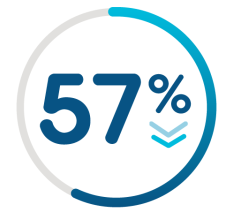
Osteoid volume/
bone volume

(OV/BV) 57% with a partial blue circle around the number

Reduction (mean, %)

Measured in 10 out of 14 patients, OV/BV decreased
from a mean (SD)
of 26%
(12.4) to 11% (6.5)

Study 5:
Secondary endpoint1,6

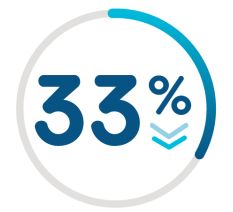
Osteoid
thickness

(O.Th) 33% with a partial blue circle around the number

Reduction (mean, μm)

Measured in 11 out of 14 patients, O.Th decreased
from a mean (SD)
of 17 (4.1) µm to 12 (3.1) µm

Study 5:
Secondary endpoint1,6

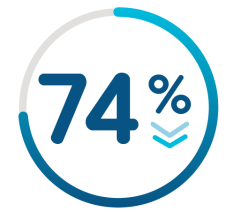
Mineralization
lag time

(MLt) 74% with a partial blue circle around the number

Reduction (mean, days)

Measured in 6 out of 14 patients, MLt was reduced from a mean (SD) of 594 (675) days
to 156 (77) days

CRYSVITA improved healing of osteomalacia at week 48, with reductions in OV/BV, O.Th, and MLt from baseline.1

††Reference values (in postmenopausal women) were defined as 0.3% to 3.1% for OV/BV; 5.5 to 12 μm for O.Th; and 15 to 50 days for MLt.7

Safety

STUDY 4 | SAFETY ENDPOINT

Clinical safety profile of CRYSVITA in adults with XLH

Adverse reactions (>5%) in CRYSVITA-treated patients and in 2 patients more than with placebo in the 24-week placebo-controlled period of Study 41

Adverse reaction CRYSVITA
(n=68)
Placebo
(n=66)
Back pain 15% 9%
Headaches‡‡ 13% 9%
Tooth infection§§ 13% 9%
Restless legs syndrome 12% 8%
Vitamin D decreased|||| 12% 5%
Dizziness 10% 6%
Muscle spasms 7% 3%
Constipation 9% 0%
Blood phosphorus increased¶¶ 6% 0%
Adverse reaction

Back pain
15%
9%
Adverse reaction

Headaches‡‡
13%
9%
Adverse reaction

Tooth infection§§
13%
9%
Adverse reaction

Restless legs syndrome
12%
8%
Adverse reaction

Vitamin D decreased||||
12%
5%
Adverse reaction

Dizziness
10%
6%
Adverse reaction

Muscle spasms
7%
3%
Adverse reaction

Constipation
9%
0%
Adverse reaction

Blood phosphorus increased¶¶
6%
0%

n=total number of patients who received at least 1 dose of CRYSVITA or placebo.

‡‡Headache includes: headache and head discomfort.1

§§Tooth infection includes: tooth abscess and tooth infection.1

||||Vitamin D decreased includes: vitamin D deficiency, blood 25-hydroxycholecalciferol decreased, and vitamin D decreased.1

¶¶Blood phosphorus increased includes: blood phosphorus increased and hyperphosphatemia.1

The 24-week placebo-controlled study was followed by a 24-week open-label treatment period in which all patients received CRYSVITA subcutaneously every 4 weeks. No new adverse reactions were identified in the OLE period.1

Adverse reactions:

A silhouette of a person with multiple circles on their body

Hypersensitivity reactions

In the double-blind period of Study 4, approximately 6% of patients in both the CRYSVITA and placebo treatment groups experienced a hypersensitivity event. The events were mild or moderate and did not require discontinuation.1

Phosphate element, as shown in the periodic table

Hyperphosphatemia

In the double-blind period of Study 4, 7% of patients in the CRYSVITA treatment group experienced hyperphosphatemia, meeting the protocol-specified criteria for dose reduction (either a single serum phosphorus greater than 5.0 mg/dL or serum phosphorus greater than 4.5 mg/dL [the upper limit of normal] on 2 occasions). The hyperphosphatemia was managed with dose reduction. The dose for all patients meeting the protocol-specified criteria was reduced by 50%. One patient required a second dose reduction for continued hyperphosphatemia.1

A syringe

Injection site reaction

In the double-blind period of Study 4, approximately 12% of patients in both the CRYSVITA and placebo treatment groups had a local reaction (eg, injection site reaction, erythema, rash, bruising, pain, pruritus, and hematoma) at the site of the injection. Injection site reactions were generally mild in severity, occurred within 1 day of injection, lasted approximately 1 to 3 days, required no treatment, and resolved in almost all instances.1

Lower leg with curved lines beside it, representing restless legs syndrome

Restless legs syndrome (RLS)

In the double-blind period of Study 4, approximately 12% of the CRYSVITA treatment group had worsening of baseline RLS or new onset RLS of mild to moderate severity; these events did not lead to dose discontinuation. Nonserious RLS has also been reported in other repeat-dose adult XLH studies; in 1 case, worsening baseline RLS led to drug discontinuation and subsequent resolution of the event.1

The vertebral column

Spinal stenosis

Spinal stenosis is prevalent in adults with XLH, and spinal cord compression has been reported. In the CRYSVITA phase 2 and phase 3 studies of adults with XLH (N=176), a total of 7 patients underwent spinal surgery. Most of these cases appeared to involve progression of a preexisting spinal stenosis. It is unknown if CRYSVITA therapy exacerbates spinal stenosis or spinal cord compression.1

Aly, a person living with XLH, standing with a suitcase and smiling

Aly,
on CRYSVITA since 2018

Want to learn more about starting your adult patients with XLH on CRYSVITA?

REQUEST A REP
Indication

CRYSVITA® (burosumab-twza) is a fibroblast growth factor 23 (FGF23) blocking antibody indicated for the treatment of X-linked hypophosphatemia (XLH) in adult and pediatric patients 6 months of age and older.


Indication

CRYSVITA® (burosumab-twza) is a fibroblast growth factor 23 (FGF23) blocking antibody indicated for the treatment of X-linked hypophosphatemia (XLH) in adult and pediatric patients 6 months of age and older.

Important Safety Information

CONTRAINDICATIONS

CRYSVITA is contraindicated:

  • In concomitant use with oral phosphate and/or active vitamin D analogs (e.g., calcitriol, paricalcitol, doxercalciferol, calcifediol) due to the risk of hyperphosphatemia.
  • When serum phosphorus is within or above the normal range for age.
  • In patients with severe renal impairment or end stage renal disease because these conditions are associated with abnormal mineral metabolism.

WARNINGS AND PRECAUTIONS

Hypersensitivity

  • Hypersensitivity reactions (e.g., rash, urticaria) have been reported in patients with CRYSVITA. Discontinue CRYSVITA if serious hypersensitivity reactions occur and initiate appropriate medical treatment.

Hyperphosphatemia and Risk of Nephrocalcinosis

  • Increases in serum phosphorus to above the upper limit of normal may be associated with an increased risk of nephrocalcinosis. For patients already taking CRYSVITA, dose interruption and/or dose reduction may be required based on a patient’s serum phosphorus levels.

Hypercalcemia

  • Increases in serum calcium have been reported in patients treated with CRYSVITA. Patients with risk factors such as pre-existing hyperparathyroidism, prolonged immobilization, dehydration, hypervitaminosis D, or renal impairment, are at higher risk of hypercalcemia. Monitor these patients for serum calcium and parathyroid hormone levels before and during CRYSVITA treatment for moderate to severe hypercalcemia. In patients with moderate to severe hypercalcemia, CRYSVITA should not be administered until hypercalcemia is adequately managed.

Injection Site Reactions

  • Administration of CRYSVITA may result in local injection site reactions. Discontinue CRYSVITA if severe injection site reactions occur and administer appropriate medical treatment.

ADVERSE REACTIONS

Pediatric Patients

  • Adverse reactions reported in 10% or more of CRYSVITA-treated pediatric XLH patients across three studies are: pyrexia (55%, 44%, and 62%), injection site reaction (52%, 67%, and 23%), cough (52%), vomiting (41%, 48%, and 46%), pain in extremity (38%, 46%, and 23%), headache (34% and 73%), tooth abscess (34%, 15%, and 23%), dental caries (31%), diarrhea (24%), vitamin D decreased (24%, 37%, and 15%), toothache (23% and 15%), constipation (17%), myalgia (17%), rash (14% and 27%), dizziness (15%), and nausea (10%).

Adult Patients

  • Adverse reactions reported in more than 5% of CRYSVITA-treated adult XLH patients and in at least 2 patients more than placebo in one study are: back pain (15%), headache (13%), tooth infection (13%), restless legs syndrome (12%), vitamin D decreased (12%), dizziness (10%), constipation (9%), muscle spasms (7%), and blood phosphorus increased (6%).
  • Spinal stenosis is prevalent in adults with XLH, and spinal cord compression has been reported. It is unknown if CRYSVITA therapy exacerbates spinal stenosis or spinal cord compression.

USE IN SPECIFIC POPULATIONS

  • There are no available data on CRYSVITA use in pregnant women to inform a drug-associated risk of adverse developmental outcomes. Serum phosphorus levels should be monitored throughout pregnancy. Report pregnancies to the Kyowa Kirin, Inc. Adverse Event reporting line at 1-844-768-3544.
  • There is no information regarding the presence of CRYSVITA in human milk or the effects of CRYSVITA on milk production or the breastfed infant. Therefore, the developmental and health benefits of breastfeeding should be considered along with the mother’s clinical need for CRYSVITA and any potential adverse effects on the breastfed infant from CRYSVITA or from the underlying maternal condition.

PATIENT COUNSELING INFORMATION

  • Advise patients not to use any oral phosphate and/or active vitamin D analog products.
  • Instruct patients to contact their physician if hypersensitivity reactions, injection site reactions, and restless legs syndrome induction or worsening of symptoms occur.

You may report side effects to the FDA at (800) FDA-1088 or www.fda.gov/
medwatch
. You may also report side effects to Kyowa Kirin, Inc. at 1-844-768-3544.

For important risk and use information, please see the full Prescribing Information for CRYSVITA.

Indication

CRYSVITA® (burosumab-twza) is a fibroblast growth factor 23 (FGF23) blocking antibody indicated for the treatment of X-linked hypophosphatemia (XLH) in adult and pediatric patients 6 months of age and older.

Important Safety Information

CONTRAINDICATIONS

CRYSVITA is contraindicated:

  • In concomitant use with oral phosphate and/or active vitamin D analogs (e.g., calcitriol, paricalcitol, doxercalciferol, calcifediol) due to the risk of hyperphosphatemia.
  • When serum phosphorus is within or above the normal range for age.
  • In patients with severe renal impairment or end stage renal disease because these conditions are associated with abnormal mineral metabolism.

WARNINGS AND PRECAUTIONS

Hypersensitivity

  • Hypersensitivity reactions (e.g., rash, urticaria) have been reported in patients with CRYSVITA. Discontinue CRYSVITA if serious hypersensitivity reactions occur and initiate appropriate medical treatment.

Hyperphosphatemia and Risk of Nephrocalcinosis

  • Increases in serum phosphorus to above the upper limit of normal may be associated with an increased risk of nephrocalcinosis. For patients already taking CRYSVITA, dose interruption and/or dose reduction may be required based on a patient’s serum phosphorus levels.

Hypercalcemia

  • Increases in serum calcium have been reported in patients treated with CRYSVITA. Patients with risk factors such as pre-existing hyperparathyroidism, prolonged immobilization, dehydration, hypervitaminosis D, or renal impairment, are at higher risk of hypercalcemia. Monitor these patients for serum calcium and parathyroid hormone levels before and during CRYSVITA treatment for moderate to severe hypercalcemia. In patients with moderate to severe hypercalcemia, CRYSVITA should not be administered until hypercalcemia is adequately managed.

Injection Site Reactions

  • Administration of CRYSVITA may result in local injection site reactions. Discontinue CRYSVITA if severe injection site reactions occur and administer appropriate medical treatment.

ADVERSE REACTIONS

Pediatric Patients

  • Adverse reactions reported in 10% or more of CRYSVITA-treated pediatric XLH patients across three studies are: pyrexia (55%, 44%, and 62%), injection site reaction (52%, 67%, and 23%), cough (52%), vomiting (41%, 48%, and 46%), pain in extremity (38%, 46%, and 23%), headache (34% and 73%), tooth abscess (34%, 15%, and 23%), dental caries (31%), diarrhea (24%), vitamin D decreased (24%, 37%, and 15%), toothache (23% and 15%), constipation (17%), myalgia (17%), rash (14% and 27%), dizziness (15%), and nausea (10%).

Adult Patients

  • Adverse reactions reported in more than 5% of CRYSVITA-treated adult XLH patients and in at least 2 patients more than placebo in one study are: back pain (15%), headache (13%), tooth infection (13%), restless legs syndrome (12%), vitamin D decreased (12%), dizziness (10%), constipation (9%), muscle spasms (7%), and blood phosphorus increased (6%).
  • Spinal stenosis is prevalent in adults with XLH, and spinal cord compression has been reported. It is unknown if CRYSVITA therapy exacerbates spinal stenosis or spinal cord compression.

USE IN SPECIFIC POPULATIONS

  • There are no available data on CRYSVITA use in pregnant women to inform a drug-associated risk of adverse developmental outcomes. Serum phosphorus levels should be monitored throughout pregnancy. Report pregnancies to the Kyowa Kirin, Inc. Adverse Event reporting line at 1-844-768-3544.
  • There is no information regarding the presence of CRYSVITA in human milk or the effects of CRYSVITA on milk production or the breastfed infant. Therefore, the developmental and health benefits of breastfeeding should be considered along with the mother’s clinical need for CRYSVITA and any potential adverse effects on the breastfed infant from CRYSVITA or from the underlying maternal condition.

PATIENT COUNSELING INFORMATION

  • Advise patients not to use any oral phosphate and/or active vitamin D analog products.
  • Instruct patients to contact their physician if hypersensitivity reactions, injection site reactions, and restless legs syndrome induction or worsening of symptoms occur.

You may report side effects to the FDA at (800) FDA-1088 or www.fda.gov/
medwatch
. You may also report side effects to Kyowa Kirin, Inc. at 1-844-768-3544.

For important risk and use information, please see the full Prescribing Information for CRYSVITA.

References:

  • 1. CRYSVITA (burosumab-twza). US Prescribing Information. Kyowa Kirin, Inc.; April 2026. 2. Portale AA, Carpenter TO, Brandi ML, et al. Continued beneficial effects of burosumab in adults with X-linked hypophosphatemia: results from a 24-week treatment continuation period after a 24-week double-blind placebo-controlled period. Calcif Tissue Int. 2019;105(3):271-284. doi:10.1007/s00223-019-00568-3 3. Briot K, Portale AA, Brandi ML, et al. Burosumab treatment in adults with X-linked hypophosphataemia: 96-week patient-reported outcomes and ambulatory function from a randomised phase 3 trial and open-label extension. RMD Open. 2021;7(3):e001714. doi:10.1136/rmdopen-2021-001714 4. Insogna KL, Briot K, Imel EA, et al. A randomized, double-blind, placebo-controlled, phase 3 trial evaluating the efficacy of burosumab, an anti-FGF23 antibody, in adults with X-linked hypophosphatemia: week 24 primary analysis. J Bone Miner Res. 2018;33(8):1383-1393. doi:10.1002/jbmr.3475 5. Data on file. 303 CSR. Ultragenyx Pharmaceutical Inc.; 2018. 6. Insogna KL, Rauch F, Kamenický P, et al. Burosumab improved histomorphometric measures of osteomalacia in adults with X-linked hypophosphatemia: a phase 3, single-arm, international trial. J Bone Miner Res. 2019;34(12):2183-2191. doi:10.1002/jbmr.3843 7. Data on file. 304 CSR. Ultragenyx Pharmaceutical Inc.; 2018. 8. Koek WNH, Campos-Obando N, van der Eerden BCJ, et al. Age-dependent sex differences in calcium and phosphate homeostasis. Endocr Connect. 2021;10(3):273-282. doi:10.1530/EC-20-0509 9. Dahir K, Roberts MS, Krolczyk S, Simmons JH. X-linked hypophosphatemia: a new era in management. J Endocr Soc. 2020;4(12):bvaa151. doi:10.1210/jendso/bvaa151 10. Sarmadi A, Razavi ZS, van Wijnen AJ, Soltani M. Comparative analysis of vision transformers and convolutional neural networks in osteoporosis detection from X-ray images. Sci Rep. 2024;14(1):18007. doi:10.1038/s41598-024-69119-7 11. Bhan A, Qiu S, Rao SD. Bone histomorphometry in the evaluation of osteomalacia. Bone Rep. 2018;8:125-134. doi:10.1016/j.bonr.2018.03.005 12. Osteoid. Science Direct. Accessed February 28, 2025. www.sciencedirect.com/topics/biochemistry-genetics-and-molecular-biology/osteoid 13. Cohen A, Drake MT. Clinical manifestations, diagnosis, and treatment of osteomalacia. UpToDate. Updated November 19, 2021. Accessed February 28, 2025. https://www.uptodate.com/contents/clinical-manifestations-diagnosis-and-treatment-of-osteomalacia

Back to top

COMM-US-CRY-0777 June 2026